Overview
Moshicam is a mobile photo editor focused on decorative frames and stickers for social and personal content. After 5 months since launch, we saw rapid growth (over 100% month-over-month), with 350k new users and 150k MAU
I redesigned the frame library and built a tagging system from the ground up to improve discovery and create infrastructure for long-term growth.
The Challenge
After growing over 100% month-over-month for 5 months, our frame and sticker library had exploded, but our discovery experience wasn't able to keep up. As a small team, we were categorizing and organizing all of our content by hand.
The problem:
Users couldn't find frames efficiently (high search usage = browsing failure)
Manual curation didn't scale as we added content
Premium content wasn't differentiated enough to drive conversion
We had no tagging system and everything relied on manual work
As the founding designer, I redesigned the library page and built a tagging system to improve discovery and create infrastructure for long-term growth.
Understanding the Problem
To understand the problem further, I dug deeper into our data:
Feature usage analysis showed frames were our core value (25% used stickers, 10% filters, <5% everything else)
Search analytics revealed users searched by mood/theme ("y2k," "birthday," "aesthetic")
Heat maps showed users were scrolling extensively but not clicking through
High search usage indicated browsing wasn't working
Key insight: Users wanted to find frames by mood and occasion, but we had no structure to support that. Every new frame required manual placement and this wouldn't scale as we grew.
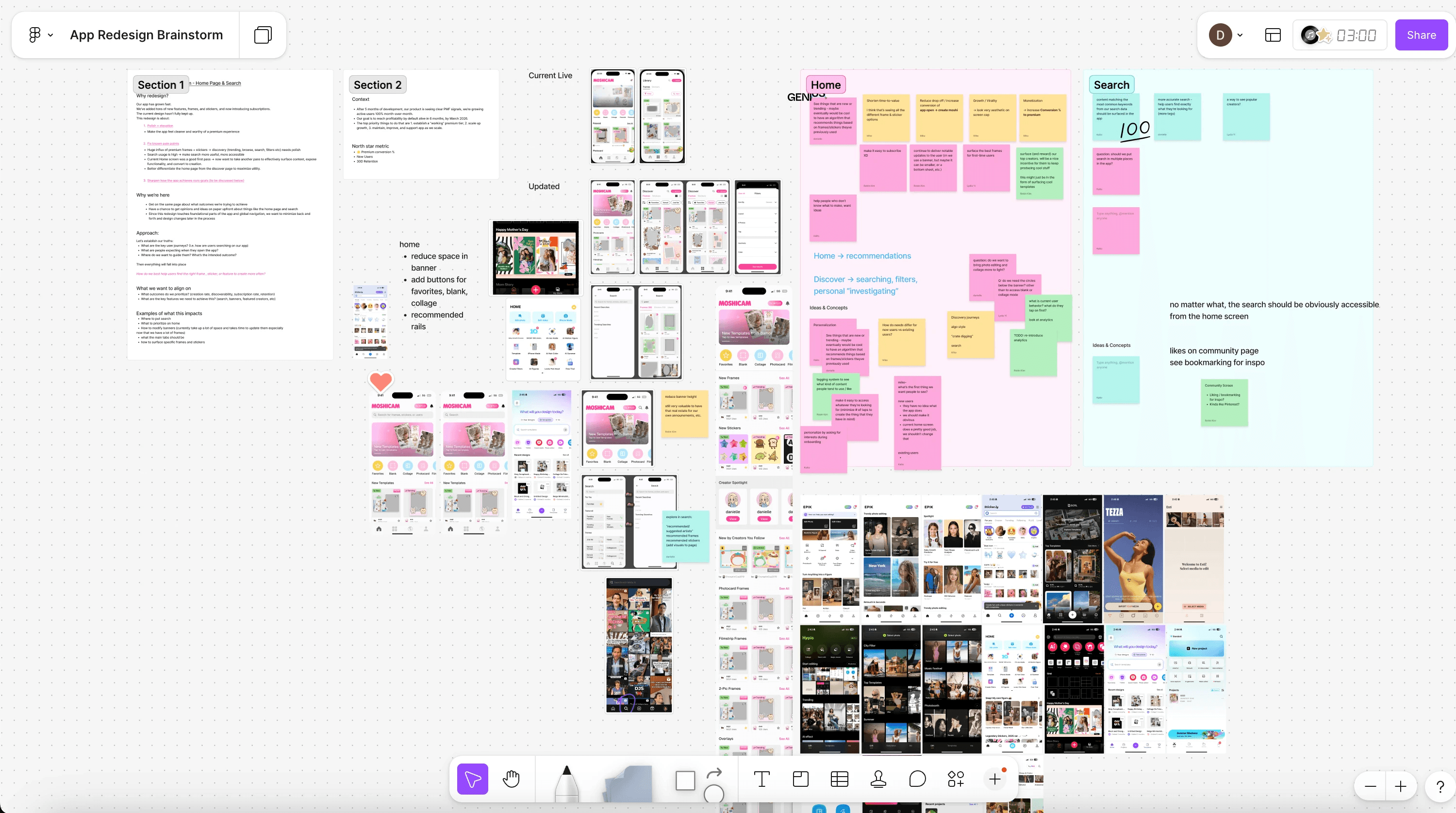
Next, I led a team brainstorm to align on priorities and discover new potential areas of opportunity:
What outcomes matter? (i.e. photo creation rate, discovery, premium conversion, retention)
What's in scope? (i.e. library page redesign, search, tagging, filtering)
What's out? (i.e. major navigation changes, personalization due to not enough time and resources)
Overview
Moshicam is a mobile photo editor focused on decorative frames and stickers for social and personal content. After 5 months since launch, we saw rapid growth (over 100% month-over-month), with 350k new users and 150k MAU
I redesigned the frame library and built a tagging system from the ground up to improve discovery and create infrastructure for long-term growth.
The Challenge
After growing over 100% month-over-month for 5 months, our frame and sticker library had exploded, but our discovery experience wasn't able to keep up. As a small team, we were categorizing and organizing all of our content by hand.
The problem:
Users couldn't find frames efficiently (high search usage = browsing failure)
Manual curation didn't scale as we added content
Premium content wasn't differentiated enough to drive conversion
We had no tagging system and everything relied on manual work
As the founding designer, I redesigned the library page and built a tagging system to improve discovery and create infrastructure for long-term growth.
Understanding the Problem
To understand the problem further, I dug deeper into our data:
Feature usage analysis showed frames were our core value (25% used stickers, 10% filters, <5% everything else)
Search analytics revealed users searched by mood/theme ("y2k," "birthday," "aesthetic")
Heat maps showed users were scrolling extensively but not clicking through
High search usage indicated browsing wasn't working
Key insight: Users wanted to find frames by mood and occasion, but we had no structure to support that. Every new frame required manual placement and this wouldn't scale as we grew.
Next, I led a team brainstorm to align on priorities and discover new potential areas of opportunity:
What outcomes matter? (i.e. photo creation rate, discovery, premium conversion, retention)
What's in scope? (i.e. library page redesign, search, tagging, filtering)
What's out? (i.e. major navigation changes, personalization due to not enough time and resources)
My Approach
I considered three directions for our solution:
1. Curation-first: Heavily curated home page with trending and collections. The issue was that it required constant manual work with updating and didn't scale with our small team.
2. Search-first: Make search the primary experience with a more minimal home page. The issue with this was that it didn't help with inspiration especially with a primarily young, gen-z audience.
3. Hybrid + Infrastructure: Redesign the UI and build a new tagging system. I chose this because it served both browsing and serving while still creating a scalable foundation.
The Challenge
The most difficult part was building a brand new tagging infrastructure with a 8-person team in less than 1 month.
This required designing a new tag taxonomy (i.e. style, mood, occasion categories), building the backend infrastructure, retroactively having to tag hundreds of existing frames by hand, and creating an efficient and long-term team workflow for tagging.
This mattered because without tags, every frame needed manual placement. With tags, we could auto-generate collections and allow frame creators to add their own tags as well as enable powerful filtering and recommendations in the future.
The Solution
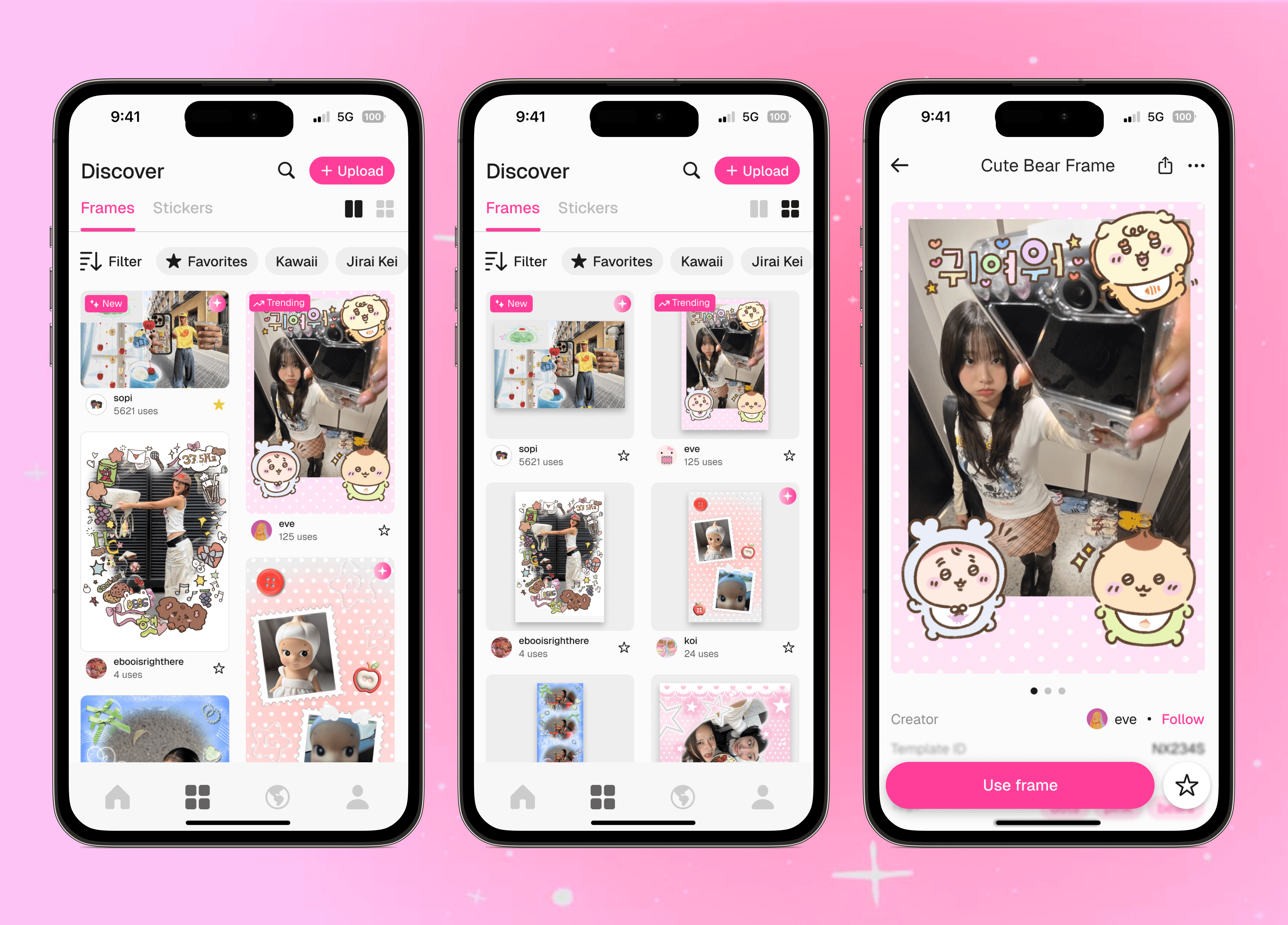
1. Redesigned Discover Page:
Tag-based collections ("Y2K," "Birthday," "Minimal")
Clear premium callouts with new tags
Cleaner hierarchy, reduced clutter
View toggle to see between grid and column views
Photo previews for frames
Filters
Frame/sticker creator labels with # of uses
Favorite button and tab
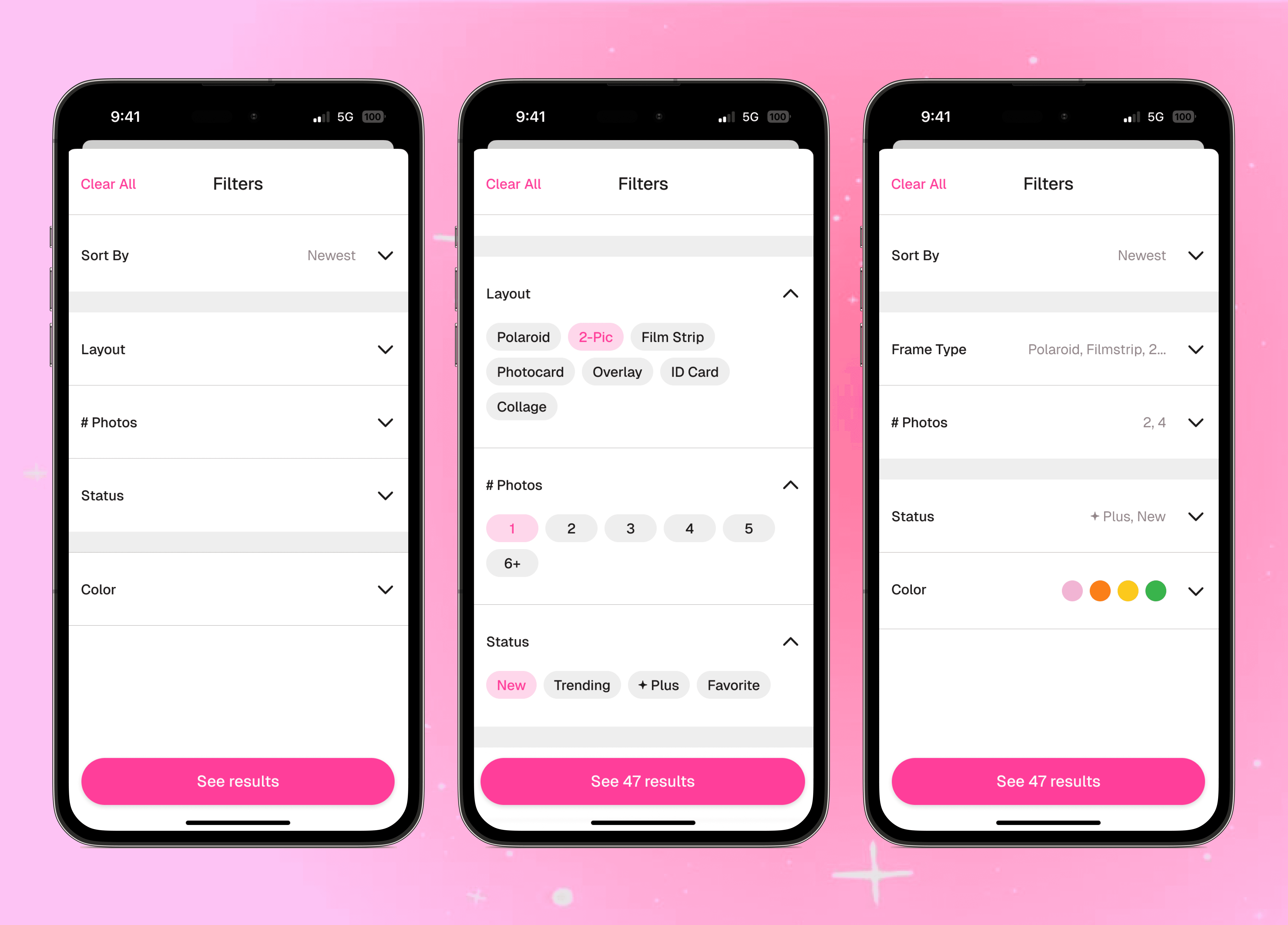
2. Improved Search & Filtering
Tag-based filters (style, mood, occasion, free/premium)
Larger visual previews
Related searches
Filter by different categories like status, number of frames, color, etc.
3. Tagging System
Frames can have multiple tags
Frame and sticker creators can add their own tags
Auto-generated collections
Below you can see the old design and how it progressed into the new design.
Results & Takeaways
Thankfully we were able to ship the feature successfully despite our small team. We were able to launch all features of the redesign within a month with a fully implemented backend and UI. Users were reporting positively to a cleaner experience with a better search and browse journey.
I learned that we should:
Think in systems, not just screens. The tagging infrastructure was harder to design than the UI, but it was the most valuable part. Good design isn't just what users see, it's the structure underneath.
Work within constraints. With a 8-person team and 1-month timeline, I had to prioritize ruthlessly. We shipped a lightweight system that could expand rather than waiting for perfection. I also knew there would be opportunities in the future to add any features that were missing.
We don't always know all the answers. You can't expect to get things done perfectly the first time around. Sometimes it takes several trials and errors and learnings to get to a good spot.
Results & Takeaways
Thankfully we were able to ship the feature successfully despite our small team. We were able to launch all features of the redesign within a month with a fully implemented backend and UI. Users were reporting positively to a cleaner experience with a better search and browse journey.
I learned that we should:
Think in systems, not just screens. The tagging infrastructure was harder to design than the UI, but it was the most valuable part. Good design isn't just what users see, it's the structure underneath.
Work within constraints. With a 8-person team and 1-month timeline, I had to prioritize ruthlessly. We shipped a lightweight system that could expand rather than waiting for perfection. I also knew there would be opportunities in the future to add any features that were missing.
We don't always know all the answers. You can't expect to get things done perfectly the first time around. Sometimes it takes several trials and errors and learnings to get to a good spot.